Search This Blog

Sunday, January 15, 2017

Hot and Fiery Venus

Venus is one of the most beautiful planets in our solar system. It was named after the Roman goddess,Venus. Venus has a thick atmosphere which is rapidly spinning. It creates a scorched world which is hot enough to melt lead. The surface pressure of Venus is 90 times than that of Earth.


Venus is the brightest planet in the night sky. Ever wondered what makes it so? Its proximity to Earth as well as the way its could reflect light makes it the brightest planet in the sky.

NASA's Magellan mission used radar to image the surface of Venus and Galileo used infrared mapping to view the mid level cloud structure.

What is a transit?
Venus can be seen periodically passing across the face of the Sun. It is called a transit.
These transits occur in pairs where a time period of more than a century separates a pair.

When considering Venus's atmosphere, it consists of mainly Carbon dioxide. The clouds are made up of sulphuric acid droplets. Trace amounts of water can also be found in the atmosphere. The atmosphere traps Sun's heat, therefore its surface temperature is over 470 degrees Celsius. Probes which land on its surface are destroyed in a few hours. Ninety percent of Venus's surface appears to be recently solidified basalt lava. Craters smaller than 1.5 km to 2km do not exist on Venus's surface as smaller meteorites burn up when entering the atmosphere.

Time in Venus!
A Venuslan year is about 225 Earth days long. It's rotational period is 243 days long. (Guess you noticed it! The days are longer than the years!!) Venus had a retrograde orbit which means it rotates from east to west. The Earth however, has a prograde orbit meaning, it rotates from west to east.

Landscape
There are more than 1000 volcanoes on Venus. There are also two highland regions. One of them is Ishtar Terra which is about the size of Australia and it is located in the north polar regions. The other is Aphrodite Terra, which is about the size of South America and it is located near the Equator. The highest mountain in Venus is Maxwell Montes.

Venus doesn't have a magnetic core similar to that of the Earth, The reason is that Venus does not rotate fast enough to create a magnetic field.




Friday, July 31, 2015

Barren Mercury!

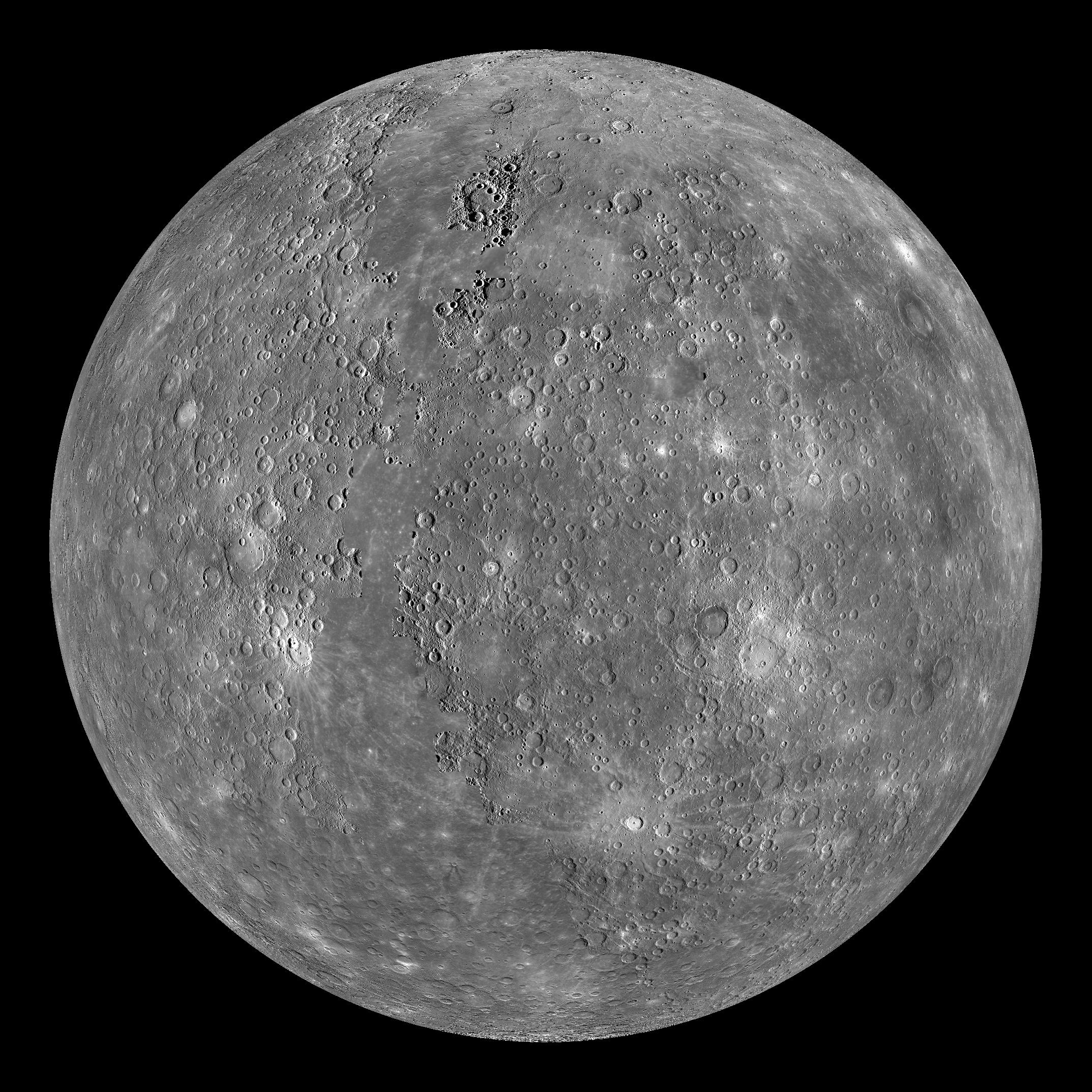
Mercury is the closest and the smallest planet in the Solar System. From Mercury the sun appears three times as large as it is viewed from earth. I believe that it is easy to understand how hot the surface of planet Mercury is because it is the closest planet to the sun. Temperature can rise up to 430 degrees Celsius and during night, temperature drops to -170 degrees Celsius as the planet does not have an atmosphere to retain the heat. 

Mercury can be observed in the sky from Earth and it makes an indirect appearance 13 times a century. We can observe a special event known as a transit, where Mercury pass across the face of the sun. The first two transits of the 21st century occurred on May 7, 2003 and November 8, 2006. The next one will occur on May 9, 2016. (Isn't it next year???! I'm excited!) 

Mercury is one of the fastest planets as it travels through space nearly 50 km per second which is the reason Mercury completes an year or a revolution in just 88 days. The surface of Mercury resembles to the Earth's moon, because of its barren surface. 

The Caloris Basin which is a result of an asteroid impact is about 1300 km in diameter. Mercury shrank in radius about 1 - 2 km as the planet cooled down after its formation. It is the second densest planet of the solar system.


Tuesday, June 2, 2015

The Solar System


The sun and its family of planets which is our immediate neighborhood is known as the solar system. The planets' moons or their natural satellites, comets, asteroids and meteoroids are all included in the solar system. Everything inside the solar system is held together with the help of the sun's gravity.

There are 8 planets in the solar system. Actually there were 9 but Pluto is not now included as a planet because of several reasons. (I will mention them later in another post).

The Inner Planets


    Mercury, Venus, Earth and Mars are considered as inner planets because they lie on the inner side of the asteroid belt which orbit the sun. The planets formed about 4.6 billion years ago and all these inner planets were formed from dust particles and they ended up being rocky planets.

Outer Planets 

Jupiter, Saturn, Uranus and Neptune are considered as outer planets as they are located outside the asteroid belt. They are also known as gas giants.

Models of the Solar System


Above is a picture of the heliocentric model which was explained by Sir Nicholas Copernicus. Later Johannes Kepler improved this model. 

Early astronomers believed that the sun and all the other planets revolved around the Earth. This concept is known as the geocentric model of the solar system. The heliocentric model which placed the sun at the centre was first introduced by Aristarchus of Samos and was later explained and developed by Sir Nicholas Copernicus. Galileo Galilee's observations with his newly made telescope strongly supported the heliocentric model.

Saturday, April 18, 2015

Our Place in the Universe : The Milky Way

Our solar system is located within a galaxy known as the Milky Way. The Milky Way appears as a dim glowing band in the night sky in which the naked eye cannot distinguish individual stars. It appears like that because its disk shaped structure is viewed from within. In 1610, Galileo Galilei resolved the band of light into individual stars. 
The Milky Way is a barred spiral galaxy and there are about 100 - 400 billion stars in the Milky Way and astronomers believe there are about 100 billion planets in it too. A disk of gas and dust known as the interstellar medium fills the space between the stars. Our solar system is located about 27 000 light years away from the Galactic Centre of the Milky Way. At the very centre is Sagittarius A*, and intense radio source, which is believed to be a supermassive black hole.

It is believed that much of the mass of the Milky Way does not emit or absorb electromagnetic radiation. This mass is known as "dark matter".

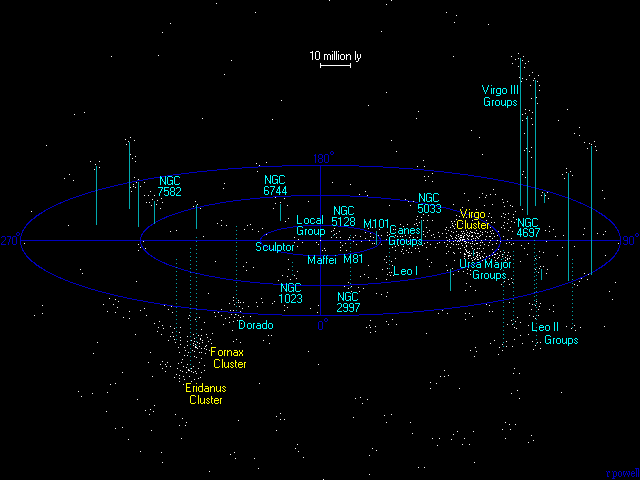
The Milky Way is a aprt of the Local Group which is a part of the Laniakea or the Local Supercluster.

Background light or stray light from the moon can greatly reduce the visibility of the Milky Way. It is very difficult to view the Milky Way from a city or a town, but it can be easily observed from a rural area. 

When we observe from the Earth, the visible region of the Milky Way occupies an area in the sky which consists of 30 constellations. The centre of the Milky Way is where the galaxy is the brightest, is located in the direction of the constellation Sagittarius.

The Milky Way which is the second largest galaxy in the Local Group is approximately 100,000 light years across and approximately 1000 light years thick. Most of the mass of the Milky Way appears to be dark matter, which only interacts in a gravitational way with other matter.


Monday, April 13, 2015

The Life Cycle of Stars


Wonderful video by the Institute of Physics. I love the explanation!

Sunday, April 12, 2015

The death of the universe - Renée Hlozek

14 Most Beautiful Galaxies In the Universe!

Black Holes: NO ESCAPE!


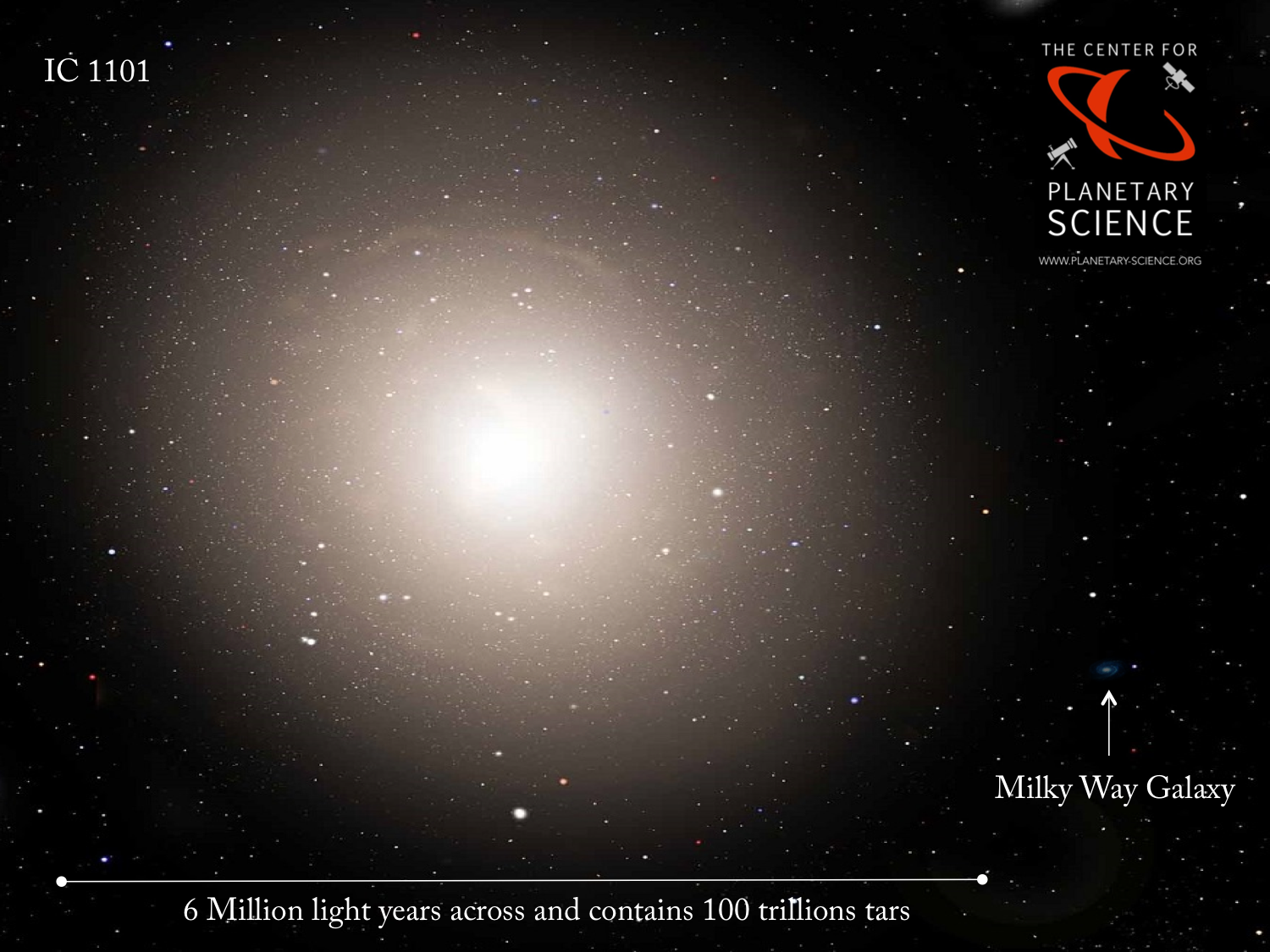
The Largest Galaxy in the Universe: IC 1101


Video by Deep Astronomy

Galaxies

A galaxy is a collection of stars, gas, dust and dark matter bound together by gravity. The word galaxy is derived from a Greek word "galaxias". Astronomers believe that there are about 170 billion galaxies in the observable universe. 

Galaxies differ enormously, yet they can be categorized according to their shape. There are spiral, elliptical, barred spiral or irregular shaped galaxies in the universe. Spiral galaxies like the Pinwheel Galaxy and the NGC 4414 galaxy consists of a flat rotating disc and a central bulge. The disc contains stars, gas and dust while the term bulge is used for a central concentration of stars in the galaxy. The spiral galaxies are so called due to the presence of spiral arms that extend from the centre to the disk. New stars are formed in the spiral arms hence they are brighter than the surrounding disk. According to Wikipedia, spiral galaxies have the following characteristics. 

  • A flat rotating disc of stars
  • A central bulge of older stars
  • A near- spherical halo of stars
  • A supermassive black hole at the centre .  (Sagittarius A* in the Milky Way)
  • A near - spherical dark matter halo


Pinwheel Galaxy

Our own galaxy, Milky Way has proven to be a barred spiral galaxy recently. In barred spiral galaxies, spiral arms wind out from a central bar. The galaxy NGC 1300 is also another example for this type of galaxy.


Milky Way galaxy
Elliptical galaxies are shaped like a ball or an egg and they're mostly made up of old stars. They don't have much star formation activity within them. Some examples for this type of galaxies are M87, M32 and IC 1101, which is one of the largest galaxies in the observable universe.

IC 1101 galaxy : an elliptical galaxy
Irregular galaxies have no specific regular shape and they contain lots of gas and dust so most of them are helpful for the formation of new stars.

Our milky way is a part of a galaxy group known as the Local Group. A group of galaxies is the smallest collection of galaxies. Normally, galaxy groups don't contain more than 50 galaxies and they are the most common structures of galaxies in the universe. I will state more about group of galaxies later in my other posts.

The Laniakea Supercluster or the Local Supercluster is where the Local Group belongs to. Superclusters are very large structures which contain large groups of galaxy clusters or groups. 

The Local Supercluster


Wednesday, December 31, 2014

Hubble Sees the Beautiful Side of Galaxy IC 335

Hubble Sees the Beautiful Side of Galaxy IC 335


Click the link to see a nice pic!!!

From NASA News Services.

Galaxies

My next post will be about galaxies guys. What is a galaxy? Well you might already know what IS a galaxy. ;) But I'm gonna speak about the types and some other little interesting facts about the beauties.


The Big Bang

Well guys this is a long post! But it's gonna be interesting........

How exactly was the universe created? Well, the answer is, we do not know an exact answer. But most astronomers now believe that the universe was created by the Big Bang. The Big Band theory was proposed by and astronomer known as Georges Lemaître.  


Astronomers still do not know when this occurred. But astronomers have assumed that it occurred 13.8 billion years ago. The Big Bang Theory states that all matter in the universe began as a hot, dense and minute speck. This speck expanded and cooled down and the elements, stars, planets, galaxies and every other thing in the universe was created. The first elements in the universe were hydrogen and helium. Then eventually stars, galaxies, planets and other elements were created.
You might wonder where this Big Bang occurred? Well, there's no place where it occurred because, before the Big Bang length, width, height or the fourth dimension of time didn't exist. It sounds very interesting, isn't it? It was the Big Bang which brought space and time into life. Our universe is still expanding as it was before, so the galaxies and everything in it are moving further and further away from us.
In 1964, Arno Penzias and Robert Wilson discovered the cosmic microwave banckground radiation. It means, they discovered the whole universe was radiating microwaves. As the explosion of the Big Bang cooled down, these microwaves were left behind. 


The Steady State Theory is the alternative for the Big Bang Theory. It says that the universe had no beginning or end, and it was ever expanding. Only few astronomers now believe in this theory.


So, if that's how the universe started, how will it end? Or will the universe actually end? There are also many theories proposed for this question.


The universe will stop its expansion if there's enough matter in the universe. The combined gravity of all those matter will halt the expansion and destroy everything in. This is known as the "Big Crunch". The Big Crunch sounds a bit thrilling and it will occur billions of years from now. But the alternative of this isn't much exciting and sounds a bit "dull". The stars in the universe will consume the hydrogen in the cosmos and eventually no new stars will be able to form and there will only be dead stars, black holes in a lifeless universe.


The Big Bang
Georges Lemaitre